
The Talent Code – Daniel Coyle
Pages: 221 | Chapters: 11 | Style: Story-Data-Meaning | Cadence: Commuting | Published: 2010

Deep within you lies the source of all your talent. Not your willpower, or genes, or natural prowess, but something more prosaic: the fatty insulation around the neurons in your brain. Much like electrical wiring, the more insulated it is, the faster and better it is at conducting a signal, so too for your brain. Recent research into this fat – myelin, to give it it’s official name – has pinpointed it as the difference between a global star and a so-so performance. The more that the connections between brain neurons responsible for that ability are insulated, the stronger the signal, the better the performance. In other words, the more talented you are.
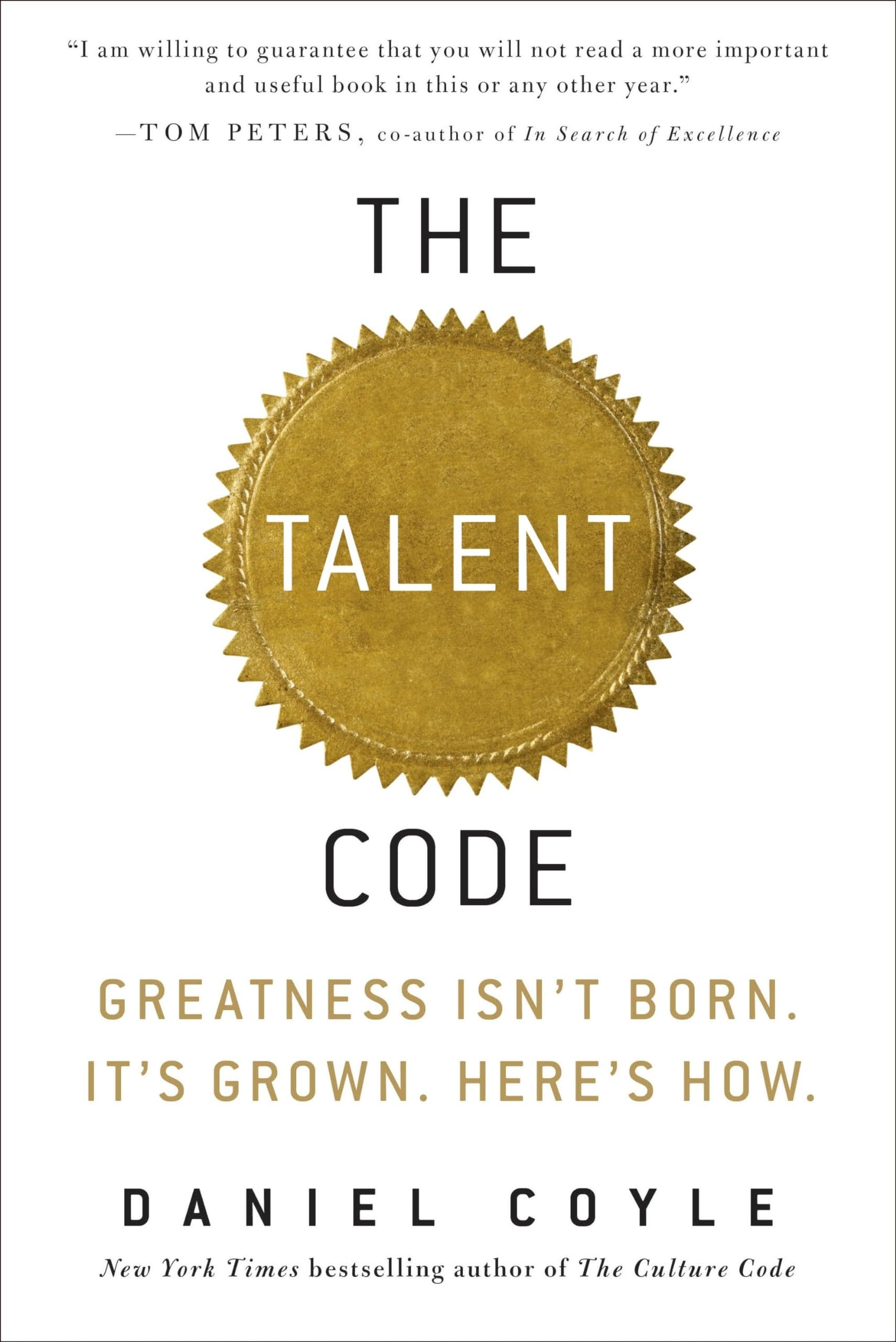
So runs the start of The Talent Code, Daniel Coyle’s investigation into talent, a global tour of talent hotbeds, with parallels to Eric Weiner’s The Geography of Genius. Taking a similar approach to his previous offering, The Culture Code, Coyle seeks to document the building blocks of talent, to identify the fundamental code. And in myelin he seems to have found it.

The remainder of The Talent Code is left for Coyle to explain how the body does this, offering up three distinct elements: deep practice, ignition, and coaching. The underlying point is that myelin doesn’t wrap around all neurons equally, the more a particular network of neurons are fired, the more that network is insulated. The way we achieve this is to first be ignited – be inspired to want to pursue a talent in the first place; second, to find a coach who can guide you; third, to repeat ad infinitum (or for 10,000 hours at least) the building blocks of the skill. The more you repeat it correctly, the more myelin will wrap and embed the talent.
There is something eerily reductive here. On the one hand, there’s a refreshing clarity to what Coyle is saying, talent isn’t an innate ability we are born with, it is something we can build. And further demystifying the biological process is important. But on the other hand, Coyle has all but removed the person from his explanation of talent; with the right inputs, of an igniting inspiration and a worldly coach, the biological brain will respond. Skinner would be proud.
To read The Talent Code then is to feel you are only getting half the story. An important part no doubt, but if all talent takes is the right input, why isn’t the world full of highly achievers? Herein lies the role of inner motivation, and for me the second half of the story. And books like Angela Duckworth’s Grit and Carol Dweck’s Mindset supply it. Afterall, if deep practice takes 10,000 hours – or nearly 10 years – to attain, surely it takes more than a good coach and an inspiring setting to keep at it. Duckworth would say one needs grit; Dweck would suggest a growth mindset.

You get the sense that Coyle sees the brain as a highly tuned car; the coach a mechanic, tweaking for optimal performance. Put in enough time – 10,000 hours – and you have a high performer. This is a train of thought found elsewhere, Malcolm Gladwell’s Outliers and Matthew Syed’s Bounce both underscore the magic of 10,000 hours. Interestingly, however, nearly all the examples given are from what David Epstein’s Range would call ‘kind’ environments.
Sport and music dominate examples of the 10,000 hours rule (indeed the rule itself was first derived from a study of two music students). Both are ‘kind’ environments, meaning there is an opportunity for instant feedback and clear distinction between right and wrong performance. Ignored in The Talent Code – and Bounce and Range – are ‘wicked’ environments, ones where feedback is slower, and the distinction of right is blurred if not confusing. In other words, most of the rest of the world, where we face more novel and different environments than the structure of a chess board, the organization of a sheet of music, or the patterns of a golf swing.
Nonetheless, The Talent Code remains compelling. Adding an important new perspective on talent and continuing to help demystify it. By reframing talent as a biological process that can be gamed through repeated practice under clear instruction, Coyle helps us all understand how we can become a little more talented.
Recommendation: Consider
Coyle’s style is an easy read and contains colourful and compelling anecdotes. However, to read it alone is to learn only half the story, instead partner it with a person-centered view of talent, such as Grit or Mindset to get the full understanding of how to master talent.